



- Calibsun | Sensor Expertise
Experiência em sensores
Como funciona
- Secure the data feeding your performance monitoring and solar forecasting.
- Configuration consultancy and operational audit
Independent audit and recommendation service
Across the development and operation of a solar power plant, every sensor, pyranometer, temperature sensor, anemometer, drives the quality check of irradiance measurements. A non-optimized sensor configuration introduces silent biases into the entire process: performance reports, machine learning algorithms, energy production assessment.
A CalibSun oferece an independent audit and recommendation service applicable to two stages of a photovoltaic project: pre-project sensor configuration and operational audit. Both rely on the same expertise. The service is deployable worldwide, since it relies solely on the client’s on-site data. It helps PV plant operators, asset managers and monitoring teams meet their measurement requirements and improve the efficiency of their photovoltaic systems.
The service covers sensor operation and data analysis only. Hardware, servers and system architecture remain the client’s responsibility.
Our methodology and scientific approach
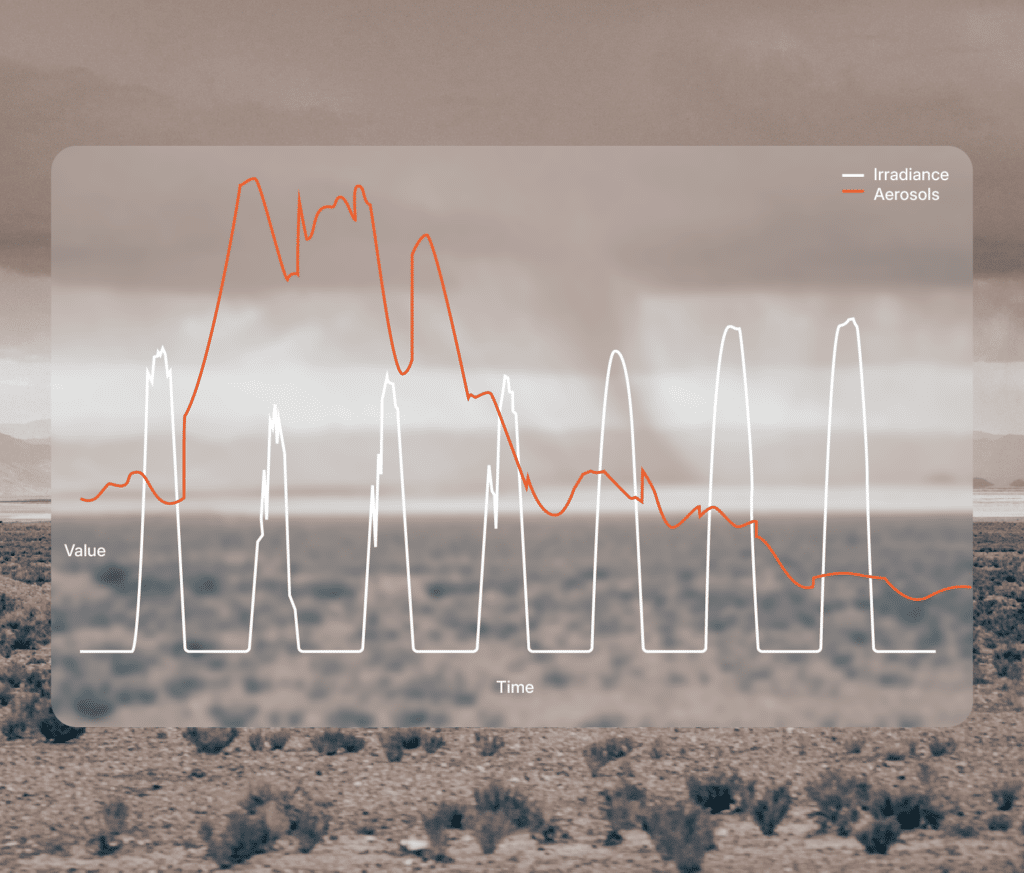
Sources of error in solar measurement sensors
Field errors observed by CalibSun fall into five categories:
- Geometric errors. Incorrect orientation — tilt, azimuth, levelling defect — introduces a systematic bias. Frequent at installation, often undetected by field teams.
- Near and far shading. Nearby structures (pylons, electrical equipment, modules) or seasonal low-sun shading degrade measurements during specific periods.
- Calibration drift. Pyranometer sensitivity drifts gradually. Invisible on a daily basis, detectable by comparison with clear-sky models.
- Environmental conditions. Soiling, frost and dew are recurring sources of error. Aggravated by unsuitable sensor choice (no ventilation or heating in exposed environments) or poor positioning.
- Data gaps. Transmission interruptions often go unnoticed when teams do not actively use the data in real time.
These errors propagate into forecasting algorithms. A 10% bias on a pyranometer translates into a 10% bias in the forecast. On a multi-hundred-MW solar power plant exposed to imbalance penalties, this can represent several hundred thousand euros per year in financial losses.
A clean sensor also allows forecast performance to be controlled in GHI, before any conversion into power generation. In monitoring, it isolates losses attributable to the photovoltaic system from losses caused by sensor errors.
Scientific background and technological independence
CalibSun’s methodology is grounded in the IEA PVPS Task 16 handbook, the recognised sector reference for on-site PV measurement. This normative framework structures all recommendations: sensor count, type, placement, audit frequency.
CalibSun is independent and has no commercial ties with manufacturers. Recommendations focus on Class A pyranometers, with 2 to 3 proven market references selected on technical merit. Specific references can be provided on client request.

- Experiência em sensores
The service
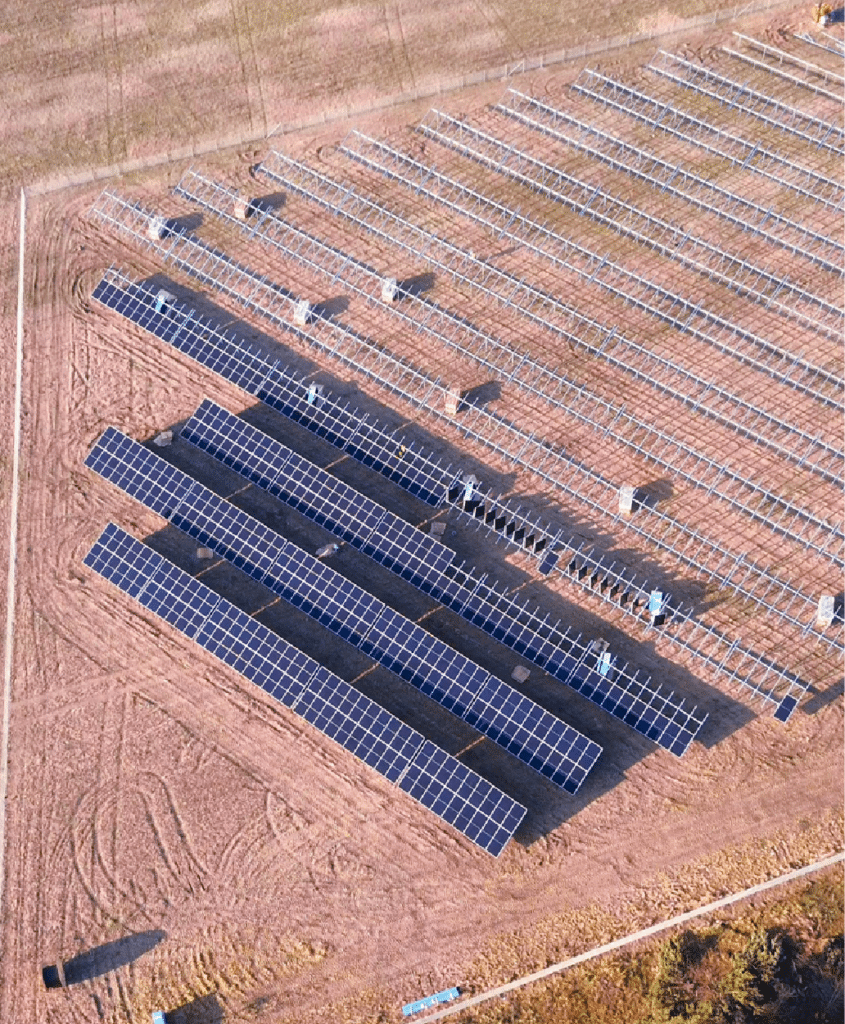
Pre-project phase: defining a rigorous measurement architecture
The client shares the site layout, plant size and PV configuration (fixed-tilt or tracker). CalibSun then delivers a complete instrumentation report covering:
- the number of sensors, calibrated to plant size — IEA PVPS Task 16 recommends ~1 sensor per 5 to 10 MW;
- the sensor type: horizontal pyranometers (GHI) as a priority, easier to install and maintain; tilted pyranometers (GTI) added on trackers to monitor backtracking setpoints;
- optimal placement: open areas, clear horizon, above modules where possible (e.g. transformer substation rooftops);
- recommended Class A references;
- a meteorological study to assess the need for ventilation or heating based on local climate;
- a spatial variability analysis to validate the planned sensor density.
For meteorological sensors: temperature sensors away from electrical heat sources, anemometers well exposed to wind, all positioned in zones representative of the whole site.
The report is directly usable by installation teams and sensor suppliers. An oral debrief by the CalibSun technical team is included. The client remains free to contact suppliers of their choice.
Criteria for optimal sensor placement
Criterion
Recommendation
Density
~1 sensor / 5–10 MW (IEA PVPS Task 16)
Primary type
Horizontal pyranometer (GHI)
Tracker case
Tilted pyranometer (GTI) in module plane
Positioning
Open area, clear horizon, no nearby shading
Specialised equipment
Ventilation / heating depending on local climate
Temperature sensors
Away from heat sources, well exposed to wind
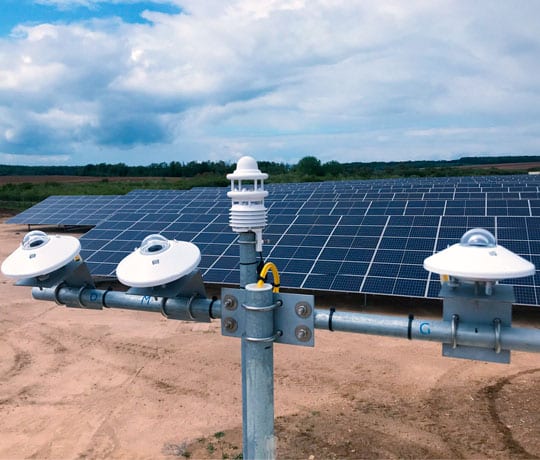
Operational phase: detecting and correcting sensor drifts
An operational audit is based on a recent data history. CalibSun applies its quality check routines and delivers a structured report including:
- performance indicators per sensor;
- analytical figures illustrating drifts, inter-sensor inconsistencies and problematic periods;
- root cause identification: seasonal shading, soiling, calibration drift, environmental issues, data gaps;
- corrective recommendations for each anomaly.
Checks include cross-validation between pyranometers, comparison with clear-sky models, correlation of degradation periods with environmental conditions, and verification of data continuity. Meteorological sensors are also reviewed: they drift less than pyranometers but serve as cross-indicators to validate irradiance measurements under varying weather conditions.
An annual audit is recommended for any plant in operation.
Precisa de mais informações?
Entre em contato!

- Perguntas
Frequently Asked Questions about on site PV sensors expertise
Does Sensor Expertise cover sky imagers?
No. The service is limited to standard monitoring sensors: pyranometers, temperature sensors and anemometers. Sky imagers are outside its scope.
Does the service include hardware or system architecture work?
No. Sensor Expertise is strictly limited to sensor operation and data analysis. Hardware, servers and system architecture remain the client’s responsibility.
O serviço está disponível internacionalmente?
Yes. It relies solely on data transmitted by the client and can be deployed on any solar project worldwide, with no geographic constraint.
How often should a sensor audit be carried out?
An annual audit is recommended during operation, to detect gradual drifts and maintain data quality over time.
- Glossary
Glossary of sensors expertise
Pyranometer
Sensor measuring global solar radiation on a given plane — horizontal (GHI) or tilted (GTI).
GHI (Global Horizontal Irradiance)
Solar irradiance measured on a horizontal plane.
GTI (Global Tilted Irradiance)
Solar irradiance measured in the plane of the PV modules.
Class A
ISO 9060 classification designating the highest-precision pyranometers, standard reference for professional PV applications.
Clear-sky model
Theoretical irradiance model under perfectly clear sky conditions. Used to detect calibration drifts.
Quality Check
Statistical and physical verification routines applied to measurement data to identify anomalies, biases and unusable periods.
Backtracking
Solar tracker control algorithm adjusting module tilt to avoid inter-row shading at the beginning and end of the day.
IEA PVPS Task 16
International Energy Agency research programme on solar integration in electricity systems, whose handbook is the sector reference for on-site PV measurement.